

Rellion Health
  • Field Notes
  • Contact
  • Rellion Health
  • Field Notes
  • Contact
Rellion Health Logo

September 16, 2026 by Stephanie Gravenor

While most of healthcare woke up to the realities of capacity challenges during the pandemic, this group had quietly been plugging away at it for years before that.

Almost a decade ago, I met Robert Fogerty, MD, MPH, SFHM in Miami at a special interest group for leaders focused on hospital capacity challenges. There were a handful of professionals in attendance, mostly from academic health systems, who had been independently advocating for their organizations to think differently about managing capacity, and came together to see what they could learn from each other. People brought the results of their improvement projects: work that had moved the needle on length of stay, or innovative solutions for caring for patients boarding in the Emergency Department. My contribution was bringing our recent research study debunking the myth that 80% was the optimal inpatient capacity target, a conclusion we’d arrived at by modeling inpatient flow using health systems engineering principles.

Three people wearing name badges stand together indoors, smiling at the camera, with drinks in hand at a professional event.

But more than the individual projects, what stood out was most conversations centered on how to begin talking to the C-suite about throughput and capacity, since there wasn’t yet widespread adoption of the language, metrics, or vocabulary needed to make the case with any sophistication. Many of us were among the only ones at our own organizations advocating for this lens on throughput at all.

Hungry for more, recognizing the need for a community dedicated to improving how hospitals care through innovation and shared learning, Rob went on to co-found Hospital Capacity Management Consortium (HCMC) together with James J Scheulen, Vikas Parekh, Heidi High, MBA, BSN, NE-BC, FACHE, which just convened its first Hospital Capacity Management Consortium Leadership Forum this past weekend. Now part of the American Hospital Association, HCMC is a collaborative of professionals working across health systems and industry partner organizations to support hospital operations.
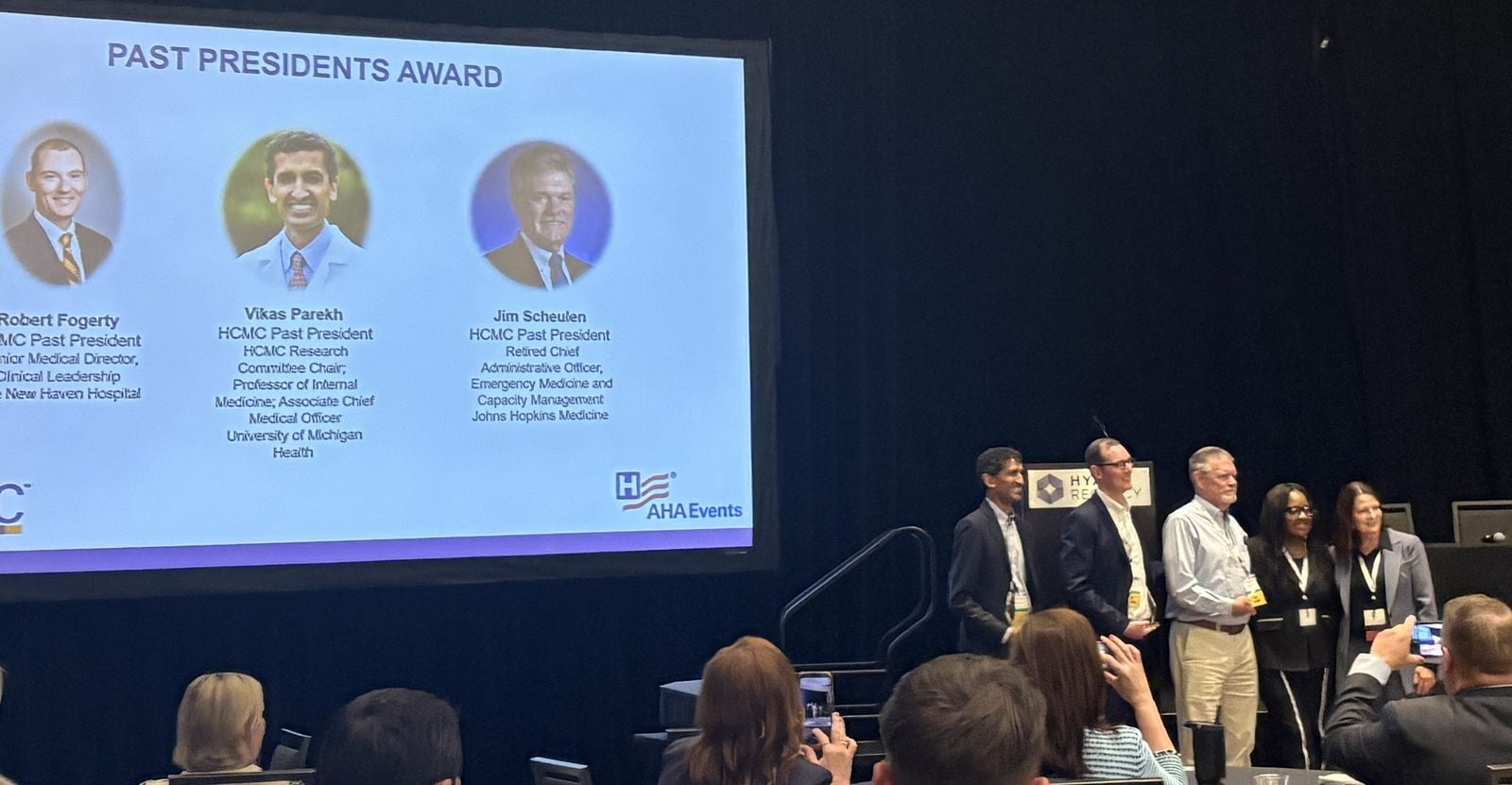
A group of people stands on stage receiving an award, with a screen behind them displaying the names and photos of past presidents.

Here’s what that decade of quiet work has produced: benchmarking reports, contributions to the scientific advancement of the field, and a “professional management group” designation under the AHA’s umbrella. In attendance were professionals from systems across the country with titles like “Chief Logistics Officer,” “Clinical Expeditor,” and “Director of Virtual Nursing”.. titles that didn’t exist ten years ago. And the conversations have grown more nuanced too: talking about “expected” length of stay relative to what’s “observed” in the data, managing variability, and the ever-present tension between access and efficiency that continues to define the field.

What an honor to attend the first Hospital Capacity Management Consortium Leadership Forum this past weekend, united around a discipline that barely had a name when a handful of us first sat down together, now a craft to be honed, and a science to be studied!

Three people pose and smile beside a “Welcome Attendees” sign at a hospital capacity event, standing in a carpeted hallway with conference badges visible.

Filed Under: Uncategorized

September 16, 2026 by Stephanie Gravenor

For years, hospital capacity planners have trusted one equation: admissions × length of stay = patient days. A new hospital operations model found that two units with identical patient days can need 16 beds apart — and it comes down to a variable that averages have always hidden. Here’s the math behind it, and what it means for planning capacity in an era of longer, more complex stays.

The Hospital of the Future Needs More Beds — Not Fewer

Why the equation everyone uses for capacity planning is quietly wrong

If you’ve ever sat in a capacity planning meeting, you’ve seen this equation on a whiteboard:

Admissions × Average Length of Stay = Patient Days

It feels airtight. Multiply how many patients arrive by how long they stay, and you get the total demand on your beds. Divide by 365, compare to your bed count, and you have your target occupancy. Clean, simple, done.

It’s also missing the one variable that actually determines whether patients get a bed when they need one: variability.

This is the question a research team from Columbia, Stanford, Johns Hopkins, NC State, University of Denver, and the Hospital Capacity Management Consortium (HCMC) set out to answer in their study on the “Hospital of the Future” — and the implications reach well past any one hospital’s bed count.

The scenario that breaks the equation

Consider two versions of the same medicine inpatient unit:

ScenarioAdmissions/DayAvg. Length of StayPatient Days
Current unit205 days100
“Future” unit — higher acuity, fewer admissions1010 days100

Same patient days. Same math on the whiteboard. Surely the same number of beds?

Wrong.

When the researchers ran both scenarios through a queuing model — holding the target ED boarding wait at 6 hours — the “future” unit needed 178 beds to hit that target, compared to 162 beds for the current one. That’s 16 additional beds to serve the exact same volume of patient days, just distributed across fewer, longer stays.

The current unit could also run hotter: 95% average occupancy versus 92% for the future scenario. In other words, the same total demand requires more capacity and a lower safe operating ceiling once length of stay climbs and arrivals slow.

Why averages lie

The reason patient days alone can’t tell you what you need to know is that hospitals aren’t factories with steady, predictable flow. Admissions bunch up in the afternoon. Length of stay is wildly skewed — a long tail of patients staying far longer than the median. Discharges cluster around midday. None of that variability shows up in an average, but all of it shows up in your ED boarding time.

A system with fewer, longer stays has less opportunity to “average out” — a single long-stay patient occupies a bed for far more of the observation window, and there are fewer other patients cycling through to smooth out the bumps. More heterogeneous, higher-acuity units need a larger capacity buffer to hit the same performance target, not a smaller one.

Three findings, one throughline

The model surfaced a small set of findings that all point the same direction:

  1. Longer stays require more beds, not more patience. Think ICU running near 60% occupancy safely, versus a general medicine unit safely running near 90%. The stay length itself changes the ceiling.
  2. Bigger, pooled units can run hotter. Economies of scale mean a long-stay patient is more likely to be “compensated” by a short-stay patient somewhere else in a larger pool — a lever that smaller, specialized units don’t have.
  3. Diverse patient populations need more buffer, not less. The more heterogeneous the mix a unit has to absorb, the lower the average occupancy it can sustain before wait times start climbing.

Why this matters beyond any one hospital

Here’s the part that should get policy makers’ attention as much as hospital administrators’: the “hospital of the future” — the one shaped by rising acuity, more complex patients, and longer stays per admission — needs more inpatient capacity to deliver the same patient experience, not less. If capacity planning keeps running on the old equation, the gap between the beds hospitals think they need and the beds they actually need will keep widening exactly as the patient population gets harder to serve.

The research team’s next step is a survey — reaching hospital systems directly to understand real capacity drivers, current measurement practices, and how administrators are actually planning for this shift today. The findings flow outward in concentric rings: from individual hospitals, to health systems, to the HCMC Consortium, to health system leaders and policy makers more broadly. Which means the answers aren’t just academic — they’re meant to change how the next generation of capacity decisions get made.


Research team: Jing Dong (Columbia University), Stephanie Gravenor (MedeCipher, CEO & Co-Founder), Yue Hu (Stanford University), Yukthasree Buchengari (NC State University), and Christopher McMahon (University of Denver), with contributions from James Scheulen, Christina Staten, Rebecca Dezube, Ting-Jia Lorigiano, and Jason Conti of Johns Hopkins.

Filed Under: Uncategorized

September 16, 2026 by Stephanie Gravenor

Operational Intelligence (OI) is a system of real-time data analytics utilized in business operations decision-making. Mathematical algorithms, applying current and historical data, evaluate alternative solutions, calculate the benefits and costs based on set objectives, and provide operational instructions. OI produces real-time information that can be applied immediately, allowing decision-makers to make informed, proactive decisions rather than reacting to issues or situations.

Traditionally used in the military, manufacturing, and general service industries to address the challenge of navigating complex decision making, OI is becoming increasingly important in the healthcare industry to address complexity in clinical operational decision-making.

One specific clinical use case is clinician scheduling – to help balance the critical need for patient care with the available supply of healthcare providers. Especially during the pandemic, it has become crucial to continue to provide appropriate staffing levels to protect patients’ safety and, just as important, alleviate burnout and fatigue in the overburdened nursing staff.

In addition to balancing supply and demand, an optimal schedule must also consider additional objectives, including:

  • Maximizing the throughput of the department (the number of patients treated in a time period)
  • Minimizing nurse overtime
  • Honoring nurse staffing preferences
  • Complying with hospital and state rules and regulations

When it comes to scheduling, it is impossible for human efforts to quickly and accurately perform the complex calculations required to solve all these objectives and satisfy the department’s constraints. Therefore it is not surprising that status quo manual scheduling methodology often results in a disregard for individual preferences, dissatisfaction with the process, unnecessary time spent correcting and managing the schedule, patient safety issues, and long patient waits.

By applying scientific solutions with proven results, OI enables healthcare organizations to design scheduling solutions that incorporate the patient and departmental complexity needed to achieve realistic and feasible solutions for clinical operations applications. The solutions take the analysis further by providing real-time decision support to ease the hassle and time involved in scheduling. The optimized schedules predict patient load and flow, prescribe appropriate staffing levels to meet the patient needs and assign staff, and adapt based on the clinical judgment of the Nursing Leadership.

Overall, these optimized schedules help improve the financial performance of a healthcare organization (by reducing their reliance on premium pay labor), improve the safety & quality of care for patients (by improving operations), and improve the quality of the work environment for nurses and providers (by justifying a safer staffing position).

Filed Under: Uncategorized

Know when we publish something new.

We'll email when there's a new post. That's it — no drip campaign, no noise.

"*" indicates required fields

Consent*

Rellion Health Footer
  • Rellion Health
  • Field Notes
  • Contact
(opens in new tab)

Privacy Policy | Cookie Policy | Terms | Disclaimer | Change Privacy Settings
© 2026 Rellion Health